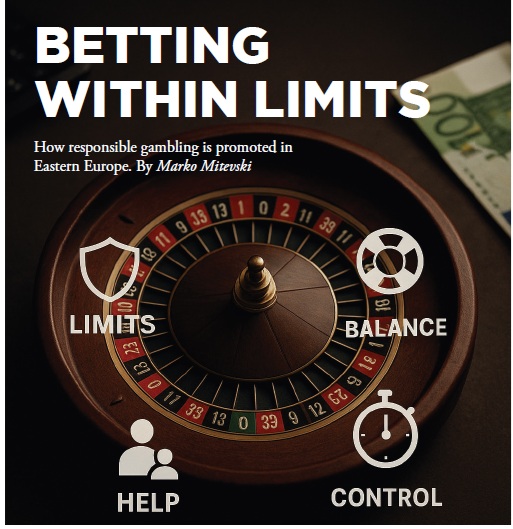

How responsible gambling is promoted in Eastern Europe. By Marko Mitevski
The past two decades have seen gambling explode in the Eastern European region. From the phenomenal rise of online-betting websites to the expansion of terrestrial casinos and sports books, gambling has been accepted as a new part of the entertainment economy in the region.
But with growth in the industry, there is an equally important need for proper responsible-gambling policies to safeguard at-risk communities. Eastern European countries are increasinglyrecognizing this requirement and implementing frameworks, campaigns and regulatory methods for promoting gambling with control. This article explores how responsible gambling is being promoted across the continent, the continuing issues and the initiatives encouraging a safer bettor’s future.
A Diverse Gambling Landscape
Eastern Europe is not uniform when it comes to gambling legislation. Some countries, like Romania, Bulgaria, and the Czech Republic, have fully legalized and regulated gambling industries. Others, like Ukraine and Serbia, are at various stages of reform. Despite the disparate legal climates, the common theme across all these nations is increasing awareness of gambling harm and the need for preventative interventions.
In countries where regulatory bodies are the most developed, like Romania’s ONJN (National Office for Gambling) and the Czech Republic’s Ministry of Finance, responsible gambling is already a regulatory obligation for operators. Licensing conditions often include mandatory self-exclusion requirements, marketing restrictions and contributions to problem-gambling-treatment funds. Meanwhile, newer markets like Ukraine are increasingly advancing their responsible-gambling initiatives, often looking to the more developed European markets as an example
Government Regulation and Legal Obligations
Governments are one of the key drivers of responsible gambling in Eastern Europe. Romania, the region’s pioneer in this respect, mandates that all licensed operators offer deposit, loss and time limits. In 2020, the ONJN established the Romanian National Self-Exclusion Registry, by which a person can exclude themselves from all licensed gambling premises and websites. This single-system process makes self-exclusion simpler to carry out and increases its effectiveness.
Similarly, the Czech Republic set up its national exclusion register in 2020. It automatically covers individuals undergoing treatment for gambling addiction or those who have been declared insolvent. Operators are required to cross-check their customer database against this list to ensure that self-excluded or vulnerable individuals are not targeted.
In Bulgaria, the State Gambling Commission requires operators to promote responsible gambling on their sites, provide links to counseling services and allow users to set personal limits. The regime of licensing includes financial sanctions for non-compliance, which acts as a deterrent to irresponsible conduct.
Industry Participation and Operator Initiatives
While government regulation is necessary, the gambling industry itself also comes to the forefront of promoting safer gambling behaviour. Top UK and global betting brands have started adding robust responsible-gambling products onto their websites.
Operators like Superbet (Romania), Fortuna Entertainment Group (Czech Republic and Slovakia) and Mozzart (Serbia) provide customers with customized deposit limits, reality checks, and reports on their gambling history. Others apply highly developed algorithms and AI tools for the detection of risky betting patterns, along with intervention through targeted messages or short-term account blocking.
In addition, Eastern European bookmakers are increasingly incorporating global responsible-gambling schemes such as the European Gaming & Betting Association (EGBA) and GamCare. These connections bring in outside specialist knowledge and foster a culture of openness and accountability.
Public-Awareness Campaigns
Changes in public opinion towards gambling are another support base for safe-gambling programs. Governments and NGOs have stepped up public campaigns to raise people’s awareness of the risks associated with gambling, and the mechanisms for access to assistance.
Within Romania, ONJN has worked in conjunction with mental health associations and media to broadcast radio and TV commercials emphasizing the importance of gambling responsibly. The “Joc Responsabil” (Responsible Gaming) campaign offers a help line, web content and one-on-one counselling. Perhaps most significantly, it speaks not just to gamblers but also their families, addressing the broader social impact of gambling damage.
Serbia also launched similar outreach programs under the Centre for the Prevention & Treatment of Gambling Addiction, in Belgrade. The center offers free counselling, educational training and a national help line. All these campaigns are highly significant in reducing the stigma related to gambling addiction and encouraging early intervention.
Education and Youth Protection
One of the most important aspects of gambling responsibility is safeguarding young people. According to studies, premature exposure to gambling – especially to sports betting and online games – can make people more likely to become addicted to gambling later in life. Regulators in Eastern Europe are taking steps to shield children from being so exposed.
All countries have implemented strict age-verification controls for online and land-based gambling websites. In the Czech Republic and Bulgaria, operators need to apply robust identity verification procedures upon opening accounts. In addition, advertising restrictions now prohibit the promotion of gambling products through media formats popular among young people.
Some countries are also incorporating gambling awareness into school subjects. Slovakia, for example, has experimented with educational workshops at secondary schools to teach students about the psychological risk of gambling, as is done with substance dependence, and about the necessity for self-control.
Technological Tools and AI Interventions
With the digitalization of gambling, technology is now used to promote responsible gaming in a more efficient manner. Advanced-monitoring systems are now able to identify unusual patterns such as frequency betting, chasing or evening betting – tells commonly associated with problem behavior.
Romanian and Czech operators are piloting behavioral-analytics tools that, in addition to identifying risk patterns, automatically issue warnings or short-term account bans. These “nudge” strategies – e.g., pop-up reminders notifying players of their losses – have been shown to reduce excessive bets without compromising user autonomy.
Various other platforms are also now creating risk profiles based on customer behavior, using machine-learning models. This is a bid to personalize interventions per user that is then likely to resonate and stave off harm.
Challenges and Gaps
Despite these advances, the journey to total responsible gambling in Eastern Europe is by no means smooth. One of the main obstacles is the illegal gambling sector. Offshore, unlicensed operators are adept at evading responsible-gambling controls. It is difficult for regulators to hold them accountable or protect users. Furthermore, the lack of harmonization across jurisdictions can lead to unequal protection. A gambler self-excluded in one jurisdiction can still access gambling websites from another if there is no data exchange between jurisdictions. Similarly, governments are unable to sustain public-health campaigns or deliver
adequate treatment services. There is also a cultural component. In some parts of Eastern Europe, gambling continues to be seen as a harmless form of entertainment and irresponsible gambling is stigmatized.
This reduces the likelihood that individuals will come for help or confess to harmful activity.
The Road Ahead
Because the market of gambling is still developing in Eastern Europe, responsible gaming will be one of the main goals. Development towards integration of legal, technological, and psychological approaches to ensuring that gambling is a controlled and entertaining game, but not a source of harm, is in progress. The future will witness greater regional cooperation, with countries sharing best practices and even harmonizing exclusion lists or treatment regimes. Improved AI tools and stricter enforcement will also reduce exposure to toxic betting.
But most importantly, maybe, responsible promotion of gambling requires an ongoing cultural shift. It must move to a view that positions gambling as a business or a form of entertainment, but also as a potentially harmful activity that must be undertaken responsibly, with industry and individual responsibility, and state regulation.
With greater awareness of such forces, Eastern Europe is gradually becoming a more sustainable, responsible and ethical gambling culture, one in which betting within limits becomes the norm, not the exception.
***This article was originally published in Sports Betting Operator Magazine Issue 018 September 2025***

Half of US offers legal sports betting as NFL season begins
EAST RUTHERFORD, N.J. (AP) — More than half of the...

Online sports betting sites score as NFL season gets under way
BOSTON (Reuters) - Top online sports betting servi...

Nasdaq dealing in Sports Betting
Nasdaq Inc. is lending its technology an...
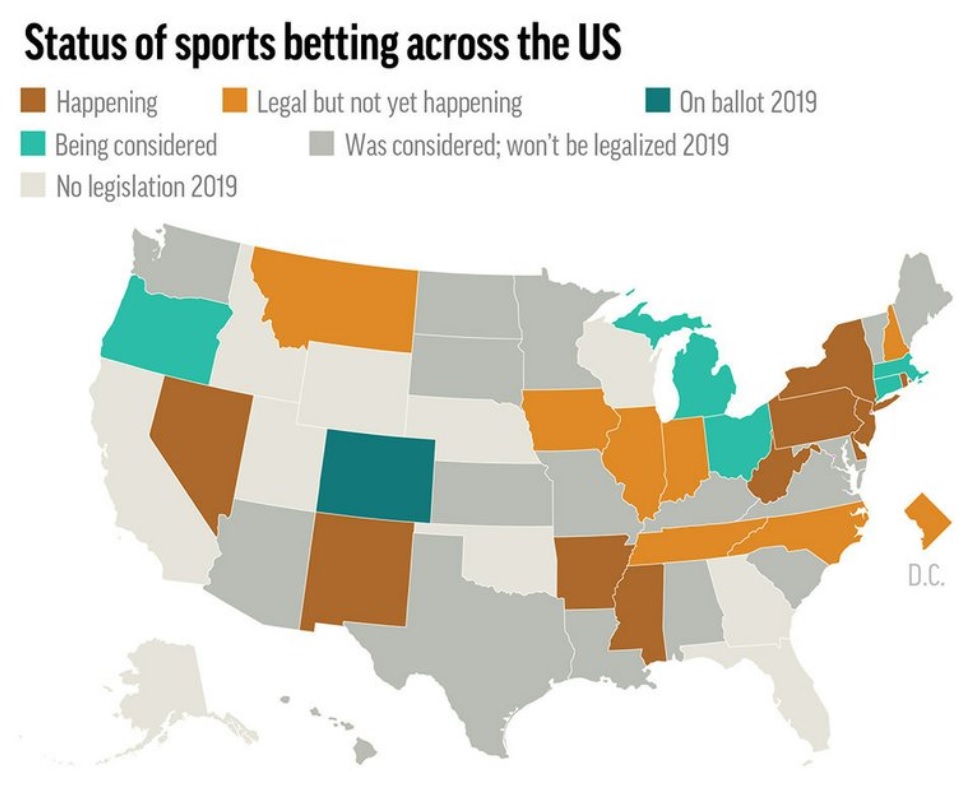
Sports betting is days away from becoming legal in Indiana
INDIANAPOLIS (AP) — Sports betting is days away fr...
William Hill US and Mescalero Apache Tribe Announce New Sports Book at Inn of the Mountain Gods Resort & Casino in New Mexico
LAS VEGAS (June 24, 2019) – William Hill US, ...