

Why traditional betting faces its extinction event. By Mark McGuinness
I come from a third-generation family steeped in sports betting. Yet for today’s socially integrated player, traditional sports books feel passive and transactional, the antithesis of Gen Z’s experience-led mindset. Prediction platforms are the natural product of an attention-driven economy and they’re reshaping everything we once knew about engagement.
Betting Bloodlines and New Frontiers
From my earliest memories, gambling in my family in Scotland meant odds and margins, not marketing campaigns. That heritage taught me that liquidity and risk management were sacred disciplines. Later, as I built affiliate programs and digital growth strategies in iGaming, I carried that same rigor into modern marketing.
But today, I find myself in conflict with my roots. For players raised on interactivity, narrative and community, traditional sports books increasingly look like relics. Online betting is passive: You choose a market, place a wager and wait. There’s no immersion, no feedback loop, no sense of participation. For Gen Z, an audience shaped by social validation and live content, that experience feels sterile.
The Rise That Cannot Be Ignored
Polymarket took center stage when Intercontinental Exchange announced up to $2 billion in investment, valuing it at about $8 billion. That was a bold statement of institutional faith. Founder Shayne Coplan has said the platform serves “a different type of user behavior – people who want to bet on real-world events beyond sports.” That framing matters. It positions prediction not as gambling but as participation in the broader cultural conversation.
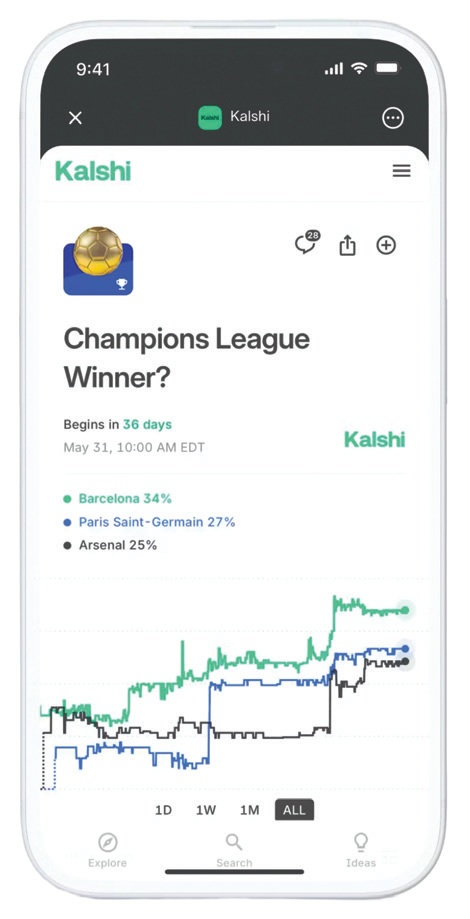
Polymarket isn’t alone. Kalshi’s valuation climbed to $5 billion after a $300 million round, more than doubling within months. Meanwhile,analysts note that DraftKings’ share price volatility now mirrors investor uncertainty about whether the sports book model can compete with agile prediction platforms. Even DraftKings’ CEO Jason Robins recently acknowledged that prediction markets could flourish “in states where online sports betting is not yet legal” – a subtle admission that the next battle for attention is already underway.

We’re in the Experience Era – and It’s Neurologically Hardwired
We are living firmly in the experience era, where attention and excitement are the currency of value. Behavioral neuroscience shows that anticipation and uncertainty activate the brain’s dopamine pathways – the same neural circuits that govern curiosity, play, and learning.
Our brains crave excitement and agency; they are wired to seek experiences that feel participatory, not passive. Traditional sports books offer closure; prediction platforms offer continuity. They turn every market into a story that evolves in real time.
In practice, prediction markets aren’t competing with sports books, they’re competing with Netflix, TikTok and the live-stream economy for dopamine. That’s why they’re winning.
Why Gen Z Sees Traditional Books as Outdated
Think about how Gen Z experiences entertainment: co-creation, conversation, community. Passive betting feels like the antithesis of that world. When I audit sports book marketing funnels, I often find no emotional hook beyond the odds. Registration, deposit, bet, outcome and that’s it. No suspense curve. No shared moment.
Prediction platforms, on the other hand, embed narrative in every trade. A user can wager on an election, watch the odds shift as news breaks, debate outcomes with others and revise positions in real time. It’s emotional theatre, the perfect fusion of speculation and story. For Gen Z, that’s irresistible. For sports books, it’s existential.

The Framing Battle
The industry’s survival depends on how it frames the prediction revolution. If prediction is dismissed as fringe speculation, sports books will lose by inertia. But if they reframe it as participatory entertainment – the natural evolution of betting – they can adapt.
Public framing is already shifting. Polymarket’s investment gives it legitimacy; Kalshi’s valuation gives it momentum. The narrative has moved from “Will prediction markets compete?” to “How fast will they dominate?”
Traditional operators still cling to arguments about liquidity and margin control. But audiences don’t crave liquidity. They crave relevance. They want to be part of something happening. That’s where sports books fail: They manage the event but they don’t animate it. To survive, sports books must stop defending old margins and start designing new emotions.
How Sports Books Can Adapt … If They’re Brave Enough
If I were advising a sports book CEO today, my directive would be simple: Reconceive the product around participation. Start by building prediction layers inside your existing ecosystem and let users speculate on cultural and political events, not just fixtures. Bring prediction markets into the UX of everyday engagement.
Next, embed community mechanics. Add live commentary, chat functions and sentiment indicators. Let odds fluctuate visibly with social energy – turn data into drama.
Then measure emotional engagement as carefully as financial turnover. Track how often users return to view odds shifts, interact with others or revise bets. Those metrics will become your new retention indicators.
Finally, recruit differently. Bring in behavioral scientists, social-content strategists and product designers who understand what triggers engagement. You can’t spreadsheet your way into relevance; you have to design for it.
A decade from now, traditional sports books may survive only as subsegments of broader prediction ecosystems. Like the dodo, they aren’t doomed by malice – just by evolution.
From Betting House to Forecasting Platform
I come from a lineage that built sports books on trust, odds and margins. But that world was built for players who watched and not for those who interact. The new generation doesn’t want to wait for results; they want to shape them.
Prediction markets turn speculation into participation. They connect culture, economics and emotion into a single dopamine-driven loop. Capital markets see it. Consumers feel it. Regulators are trying to catch up.
And maybe that’s why betting shops still survive in today’s multi-channel gambling ecosystem. They offer something online sports books no longer do: socialization, conversation and community. People go not just to place a bet but to be part of something. That sense of belonging – the shared thrill, the human contact – still matters. It’s the one emotional dimension that prediction markets have learned to replicate and that digital sports books have largely forgotten.
Traditional sports books can still adapt, but only if they stop thinking in transactions and start designing for experiences. In this new era, attention is yield and excitement is margin.
The forecast, fittingly, is clear: The experience economy has arrived. The only question left for sports books is whether they evolve … or go extinct
 Mark McGuinness is a global marketing leader with 20-plus years of experience across Web3, iGaming, and crypto. He specializes in building community-first brands, scaling growth strategies, and integrating NFTs, tokens and decentralized ecosystems into engaging digital experiences. As CMO of Devilfish.com, he is redefining social poker for a new generation of free-to-play players via monetization of digital avatars and micro-transactions within the co-creator ecosystem.
This exclusive article was originally published October 2025 edition of Sports Betting Operator Magazine Issue 019 Volume 8

William Hill Sportsbook Officially Opens at Capital One Arena in Washington, D.C.
WASHINGTON, May 26, 2021 /PRNewswire/ -- Marking a...

Nasdaq dealing in Sports Betting
Nasdaq Inc. is lending its technology an...

Half of US offers legal sports betting as NFL season begins
EAST RUTHERFORD, N.J. (AP) — More than half of the...
Sports betting is days away from becoming legal in Indiana
INDIANAPOLIS (AP) — Sports betting is days away fr...

William Hill US and Mescalero Apache Tribe Announce New Sports Book at Inn of the Mountain Gods Resort & Casino in New Mexico
LAS VEGAS (June 24, 2019) – William Hill US, ...