Prediction markets have started to occupy the awkward, lively patch where finance, gambling, and media all crowd the same pavement. FanDuel’s new Predicts platform matters because it brings the country’s biggest sports betting brand into that patch with a product built around event contracts rather than standard sportsbook wagers. The distinction sounds technical until you look at the plumbing. These contracts sit under federal derivatives oversight, not the state-by-state sports betting system most bettors know. That shift changes who regulates the trade, where FanDuel can offer it, and why the launch has stirred so much argument inside gambling and trading circles.
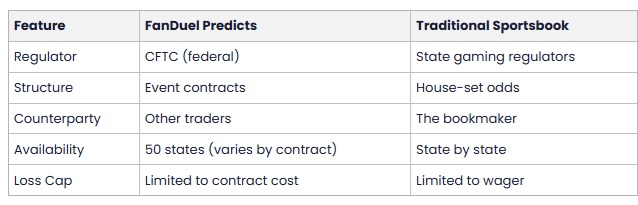
FanDuel Predicts is not a sportsbook. It operates as a federally regulated event contracts marketplace under the Commodity Futures Trading Commission (CFTC), rather than a state-licensed sports betting platform. Instead of placing wagers against a bookmaker, users trade contracts that settle at $1 if the outcome happens and $0 if it does not.
The product itself is real and live. CME Group and FanDuel announced the partnership in November 2025, launched FanDuel Predicts in five states in December 2025, and then expanded access through early 2026. The app now lets users trade on sports where available, along with economics, financials, crypto, and other real-world outcomes, with nationwide availability varying by market. Reuters reported that Flutter, FanDuel’s parent, plans heavier investment in the platform during 2026, which shows this is more than a side experiment dressed up for investor day.
Prediction markets and new platforms like FanDuel Predicts now sit in the same consumer discovery funnel as traditional sportsbooks. Readers browsing what’s available on SBR and other similar platforms will increasingly encounter event contract products alongside bonus offers and sportsbook comparisons. FanDuel Predicts blends into that ecosystem visually and structurally, yet it operates under federal derivatives oversight rather than state gaming regulation. The app may feel familiar, but the regulatory plumbing underneath it is materially different.

Why FanDuel wants this lane
The obvious reason is reach. Predicts gives FanDuel a way into places where standard online sports betting still lacks a legal path. CME said at launch that the app would offer sports contracts in states where online sports betting is not yet legal, except on tribal lands, while still offering financial and economic contracts nationwide. FanDuel Predicts has now gone live across all 50 states, with sports contracts limited to states where FanDuel does not already run a sportsbook. For a company built on sports acquisition, that is a clever map. It opens a door in California and Texas without calling the product a sportsbook.
It also places FanDuel inside a fast-growing corner of the market. Reuters reported this week that major exchange operators, including Nasdaq, ICE, Cboe, and CME, are all pressing further into prediction products as interest grows. Another Reuters report from February said Flutter expects FanDuel Predicts investment to trim 2026 profit by as much as $300 million, which sounds expensive until you remember what a customer list in new states can be worth later. FanDuel is paying for a new frontier while the fences are still being drawn.
What bettors should actually watch
For users, the attraction lies in familiarity. FanDuel says you can buy yes or no positions, you can cash out if that function is available, and you can never lose more than you put in. That makes the learning curve lighter than a lot of trading products. It also helps explain why prediction markets can feel closer to betting than to brokerage. A user who already understands live betting, price movement, and quick settlement will recognize the tempo. It is less like a dense futures terminal and more like a slick cousin of virtual sports, where the interface does a lot of the social work and the product asks you to keep up.
The harder question concerns law and market structure. Critics argue that sports event contracts can function like a back door around state gaming rules and tribal arrangements. Gambling Insider reported sharp criticism from the California Nations Indian Gaming Association after FanDuel expanded sports contracts there. At the federal level, the CFTC’s February enforcement advisory also showed that prediction markets now face the kind of fraud and misuse risks that arrive whenever money meets information gaps. So the issue is what kind of market it becomes once regulators, tribes, exchanges, and operators all decide how hard they want to pull on the rope.
The details worth reading before you tap
FanDuel’s support pages already separate general tax and forms guidance across products, which tells you the paperwork side of this business stays important no matter how smooth the app looks. Users who treat Predicts like a casual flutter would do well to read the platform disclosures and tax information before they trade in size, because event contracts live in a category with different oversight and documentation habits than a normal sportsbook ticket. The fun part arrives fast. The forms tend to arrive later, and they have long memories.
Practical reading helps here. FanDuel’s risk disclosure explains that these are exchange-traded event contracts. SBR’s guides and betting calculator tools show how much gambling media now tries to meet users halfway by translating numbers into something usable. That instinct matters more in prediction markets because the product borrows language from trading while courting people who think in bets. When a market starts speaking two dialects at once, you do best by slowing down and reading both.
FanDuel Predicts vs Traditional Sports Betting
Your checklist before starting
- Read the FanDuel Predicts FAQ and risk disclosure first. They explain who regulates the product, who holds the account, and how losses work.
- Check whether sports contracts are actually offered where you are. FanDuel says markets vary by location.
- Treat it as its own product class. It may feel like betting, though the regulatory framework is the CFTC and the NFA rather than a state sportsbook regime.
- Read the tax and forms guidance before you build volume. Clean records make a calmer year.
FanDuel Predicts looks important because it is important. It gives FanDuel a federal route into a market that sits beside sports betting while borrowing much of its language, pace, and appeal. For bettors and industry people, the platform offers a useful test case.
FanDuel Predicts may become the most important test case in the next phase of U.S. wagering. If event contracts survive regulatory pressure, sportsbooks could gain a federal expansion channel that reshapes the balance of power between state gaming regulators and financial exchanges. If they don’t, this may mark the moment regulators drew a clear line between betting and derivatives. Either way, the outcome will influence far more than one app.
Online sports betting sites score as NFL season gets under way
BOSTON (Reuters) - Top online sports betting servi...

Half of US offers legal sports betting as NFL season begins
EAST RUTHERFORD, N.J. (AP) — More than half of the...

Quick On The Draw
Ribbon-cutting at Valley Forge Casino Resort, Marc...

William Hill US and Mescalero Apache Tribe Announce New Sports Book at Inn of the Mountain Gods Resort & Casino in New Mexico
LAS VEGAS (June 24, 2019) – William Hill US, ...
The owners of FanDuel and PokerStars have struck a $12 billion deal to create the world's biggest online betting
The owners of FanDuel and PokerStars have struck a...